AI influencers that went viral in 2025 and 2026, and what they have in common
7 min read
The AI influencers and characters that went viral in 2025 and 2026 share a build: one figure with a fixed look, doing one thing again and again, in a new place each time. A man shadowboxing, a pink-clad grandmother giving blunt advice. Below are eleven cases, with who made each one, when, and numbers that carry their date and source.
Counts are as reported on the date given, so the same account shows different numbers in different places. For the definition, start with what an AI influencer is. Older characters such as Lil Miquela, who first posted in April 2016 (Wikipedia), are 3D models and are left out. Virtual vs AI influencer compares the two.
AI characters that went viral in 2026
Jean Philanthrope ("Jean Phil"), September 2026
Jean Philanthrope is a silent character in a brown suit, with a blond bob and a curled mustache, who shadowboxes in settings that get more absurd with each post (Dexerto, September 25). His first known post is from September 17, according to Know Your Meme (September 24) and the newspaper O Tempo; the Belgian broadcaster VRT mentions one of his first videos, from September 18. In three days, per Know Your Meme, a street clip set to La Fève's "FINIS-LES" passed 1.5 million TikTok views, and a Paris park clip set to Nelly's "Dilemma" passed 5.6 million. LADbible counted 35.9 million views on a single video on September 30, and VRT counted about 270,000 TikTok and 240,000 Instagram followers in October 2026.
The creator has not been identified, and no tool is confirmed. An anonymous person told VRT that AI plays a role in the process but the videos are not fully AI-generated. A memecoin with his name lost more than 99% of its value on September 21, Bored Panda reported. More in Who is Jean Phil?
Archibald Brown and the copies
About a week after Jean Phil's first known post, Dexerto reported an English "rival", Archibald Brown, with more than 110,000 followers and a token of his own, and a smaller copy, Derek Mercer, with more than 1,200.
Fruit Love Island, March 2026
Fruit Love Island is an AI microdrama in which fruits that behave like people take part in a Love Island-style dating show. It started on March 13, 2026, and nine days later had more than 3 million followers, with more than 300 million views in total and more than 10 million per episode on average, according to Wikipedia. The anonymous creator stopped posting new episodes on March 28. No tools are named.
The orange-tracksuit account, Brazil, October 2026
On October 8, 2026, the Brazilian newspaper O Tempo reported a Brazilian account that uses AI to make Vector, the orange-tracksuit villain of Despicable Me, appear in videos of well-known people. The paper raises copyright and image-rights questions and mentions courses that sell the formula. How many followers the account has, and since when, is not confirmed. The Vector article covers what is known and what is not.
AI characters that went viral in 2025
Granny Spills, July 2025
Granny Spills is a fictional 75-year-old grandmother in pink designer outfits who gives blunt luxury-lifestyle advice. Eric Suarez (TIME spells it Suerez) and Adam Vaserstein of Blur Studios created her in July 2025. TIME reported in November 2025 about 400,000 TikTok and 1 million Instagram followers within her first few weeks, and that her creators make a video in 5 to 10 minutes with tools such as Google's Veo. Kolsquare, an influencer-marketing platform, counted 1.9 million Instagram followers in August 2026.
Big Yowie, July 2025
Big Yowie is a series of AI Bigfoot vlogs made by a software engineer who goes by Seiji, with Google's Veo 3 and ChatGPT-drafted shot prompts. In July 2025, Kapwing, a video-tools company, gave more than 250,000 followers and 35 million views from 20 posts. It put the cost of a short video at $50 to $150 and wrote that the series was still operating at a loss.
Italian brainrot, from early 2025
"Italian brainrot" is a family of absurd AI-made hybrids with Italian-sounding names and AI narration, such as Tralalero Tralala and Tung Tung Tung Sahur. They emerged in early 2025, says Wikipedia. Tung Tung Tung Sahur came from an Indonesian TikTok user, Fernanda Bagas Indrastata ("Noxa"), who made the image with DALL-E and first posted it on February 28, 2025 (Wikipedia). By April 2026 two of the characters, Tung Tung Tung Sahur and Ballerina Cappuccina, each had a Fortnite skin, and there is a Panini sticker album.
Mia Zelu, 2025
Mia Zelu, made by anonymous creators, debuted in March 2025 and went viral that July with posts from the front row at Wimbledon. Tennis.com counted more than 160,000 followers on July 16 and noted that her AI origin appears only behind a "Read More" in her bio.
Tilly Norwood, September 2025
Tilly Norwood is an AI "actress" from Xicoia, the AI division of Particle6. She was announced on September 27, 2025, at the Zurich Summit and had about 50,000 Instagram followers by October 3. The actors' union SAG-AFTRA said it does not consider her an actress (Wikipedia).
Marisa Maiô, June 2025
Marisa Maiô is an AI talk-show host in a black swimsuit, made, according to Canaltech, by the Rio-based creator Raony Phillips with Google's Veo 3. Her first video went up on June 3, 2025, and had 2.3 million Instagram views and 1.7 million on X within days (Canaltech, June 9). Magazine Luiza (Magalu) used her in a Dia dos Namorados post that passed 4 million Instagram views in two days (Consumidor Moderno, June 10), and OLX posted a video with her on June 11 (Meio & Mensagem, June 12). No fee appears in the reports we read. More in Brazil's AI influencers.
Dona Maria, June 2025
Dona Maria is an AI avatar of an elderly woman, a political account that posts criticism of Brazil's federal government and Supreme Court, and it first appeared in June 2025. Terra (April 27, 2026) and BBC News Brasil, published by O Povo (April 21) put it at 751,000 Instagram followers and one July 2025 video at 8.8 million views, and its creator says a video costs about R$ 20 in credits. On April 22, 2026, three political parties asked the electoral court to suspend its profiles, according to Terra.
What do the AI characters that went viral have in common?
The cases that grew fastest, Jean Phil, Granny Spills, Big Yowie and Fruit Love Island, share five things with several of the others.
- A look that fits in one sentence. A man in a brown suit with a blond bob and a curled mustache. A 75-year-old in pink designer outfits. A Bigfoot. Fruit in a dating show. Each is recognizable in a thumbnail.
- One action, repeated. Shadowboxing. Blunt advice. A vlog. Dating-show drama. The viewer knows what the next post is before it loads, and only the place changes.
- Clips that are quick and cheap to make. Granny Spills' creators say 5 to 10 minutes a video, Dona Maria's creator about R$ 20, and Kapwing $50 to $150 for Big Yowie. Google's Veo is named in three of the cases.
- Copies within days. Archibald Brown had passed 110,000 followers about a week after Jean Phil's first known post. Whoever starts a format has a short lead.
- Money that comes sideways, or not at all. A memecoin that lost 99% of its value, a brand post after the fact, a Fortnite skin, a series still running at a loss. Dona Maria's creator told the BBC that the main income comes from elsewhere, and not from the page.
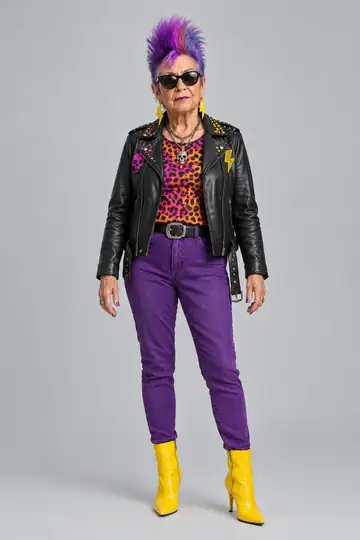
The same rule works for a character you invent. Vó Trovão, from the Duble AI cast, is a woman of about 70 with a tall purple-and-blue mohawk and cat-eye sunglasses. One sentence describes her, and the mohawk is what you remember.
This is a list of survivors. It says nothing about how many accounts tried the same formula and got nowhere, which is why it describes a pattern and not a method. How to go viral with an AI influencer turns the pattern into a plan and says plainly what no plan can promise. To try it with a character of your own, create your influencer.
Frequently asked questions
- Is an AI influencer a real person?
- No. An AI influencer is a character made with AI tools, and a real person or a team runs the account. Some creators say who they are and some stay anonymous. When a post is AI-made, the platform you post on may ask you to label it.
- How are AI influencers created?
- The look is fixed first, from a written description or reference photos. The videos are then made either by generating each scene from a text prompt or by putting the same character into a video that already exists. Duble AI works the second way: you pick the trend, and your character takes the place of the person in it.
- How do AI influencers make money?
- The usual routes are sponsored posts, affiliate links, UGC made for brands, subscriptions, their own products and platform payouts. None of it is guaranteed. Among the 2025 and 2026 cases the money was indirect, such as brand posts and merchandise, and at least two creators said they earn little or run at a loss.
- Can I make an AI influencer like these?
- You can make a character of your own and put it into trends and into videos you film. Duble AI starts from a description, your photos or a ready-made character from the cast, and creating it costs nothing up to 3 images. Whether a profile takes off depends on things nobody controls.